
SD-WAN - Control Plane
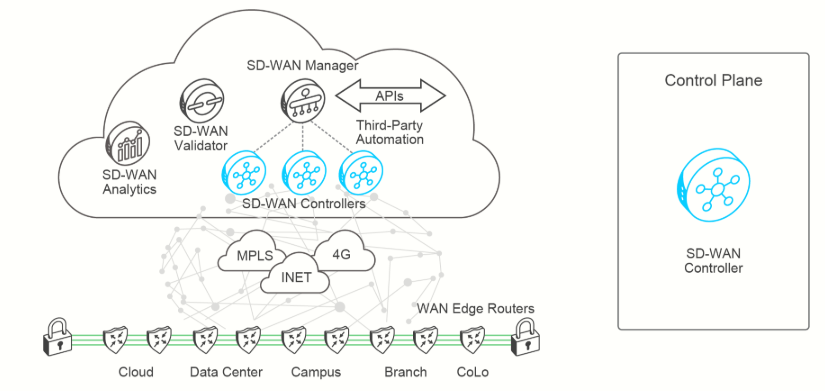
Cisco Catalyst SD-WAN Controllers provide a highly resilient, scale-out control plane for the SD-WAN fabric.
Key Characteristics
-
Fabric Discovery & Control: Facilitates fabric discovery and distributes control plane information, data plane policies, and application-aware routing policies to WAN Edge routers.
-
Policy Implementation: Executes control plane policies (e.g., service chaining, multitopology, multihop).
-
Simplicity & Resilience: Drastically reduces control plane complexity and is highly resilient.
Fabric Discovery & Information Distribution
-
OMP Protocol: SD-WAN Controllers run the Overlay Management Protocol (OMP) with each other and with WAN Edge routers to facilitate fabric discovery.
-
Data Plane Establishment: Controllers and WAN Edge routers distribute essential data to establish direct data plane connectivity between WAN Edge routers.
-
Shared Data Types: This distributed information includes LAN-side reachability, transport-side IP addressing, IPsec encryption keys, site identifiers, and other details.
Centralized Control & Policy Enforcement
-
Route Reflector Model: WAN Edge routers send all control updates to an SD-WAN Controller, which reflects them to all remote sites.
-
No Direct Control Channels: Because of this centralized model, every router learns about all tunnel endpoints and user prefixes without needing direct control channels between each other.
-
Policy Distribution: Controllers distribute data plane and application-aware routing policies to WAN Edge routers for local enforcement.
-
Control Plane Policies: Policies affecting control plane info are enforced directly on the controllers. They influence traffic flow across the fabric and implement:
-
Service chaining (e.g., inserting firewalls in the data path).
-
Topologies (e.g., hub-and-spoke, partial-mesh, full-mesh).
-
Complexity Reduction & Deployment Models
-
Solving n^2 Complexity: Centralization eliminates the high control plane load traditionally needed for large IPsec networks, solving the n^2 complexity issue.
-
Scalability & Resiliency: The controller deployment model ensures horizontal scaling and high availability.
-
Deployment Options:
-
Geographically Dispersed: Often placed in separate physical data centers to prevent total control plane failure.
-
Cisco Cloud Service: Redundantly hosted in the Cisco cloud.
-
On-Premises: Deployed by the customer, who must then provide the infrastructure resiliency.
-