
SD-Access - Overview
1. Underlay vs. Overlay: The Core Architecture
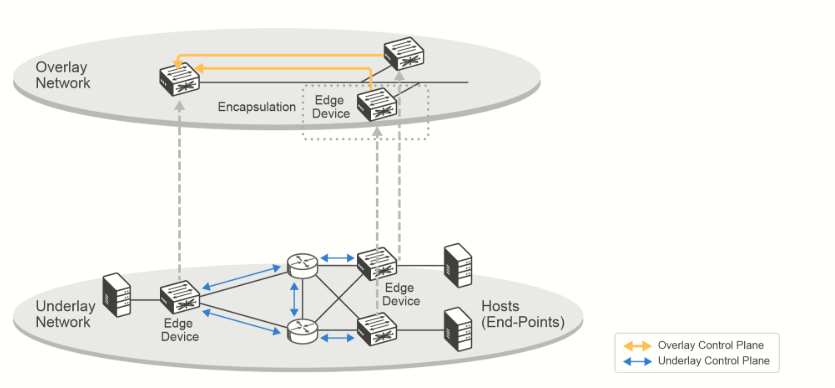
An SD-Access fabric works by running a virtual logical network (the Overlay) on top of a physical hardware network (the Underlay).
| Feature | Underlay Network (The Physical Foundation) | Overlay Network (The Virtual Fabric) |
| What it is | Physical switches, routers, and cabling. | A logical, virtualized topology built on top of the physical hardware. |
| Primary Role | Establishes physical, edge-to-edge IP reachability. | Isolates data and control plane traffic to support multitenancy. |
| How it works | Uses standard IP routing protocols. End-user subnets are not part of it. | Encapsulates user traffic in tunnels (adds a 50-byte fabric header). |
| Visibility | Completely visible to administrators. | Completely invisible to end hosts. |
| Examples | Traditional L3 routed access networks. | GRE, MPLS, IPsec, DMVPN, LISP, CAPWAP, ACI. |
2. Underlay Provisioning: Manual vs. Automated
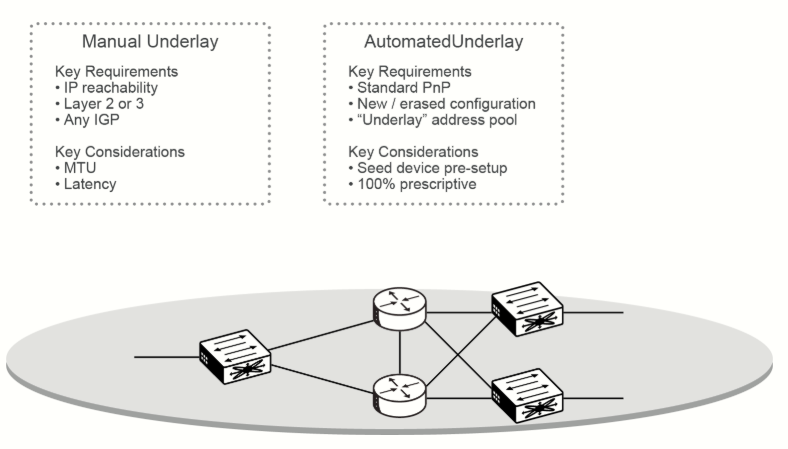
You can build your physical underlay manually (reusing existing infrastructure) or automate it from scratch using Cisco DNA Center.
| Aspect | Manual Underlay | Automated Underlay (LAN Automation) |
| Best For... | Reusing your existing network. | Greenfield (new) deployments or wiped devices. |
| How it works | Manually configured, then imported/discovered. | Fully automated bootstrap using Plug-and-Play (PnP). |
| Key Requirements | IP reachability edge-to-edgeL2 or L3 (L3 highly recommended)Any IGP routing protocol | Standard Cisco PnP bootstrap. Devices must have a clean/erased configRequires a global "underlay" IP address pool |
| Why IS-IS? | Recommended. Scalable and integrates perfectly with DNA Center. | Prescriptive (Required). Offers IP-agnostic peering, loopback peering, and no IP-dependency for neighbors. |
| Crucial Limits | MTU: Must accommodate the extra 50-byte fabric header. Latency: Round-trip time (RTT) must be ≤ 100ms. | Customization: 100% prescriptive (non-customizable). Requires a pre-setup "seed" device. |
3. Cisco SD-Access Components & Roles
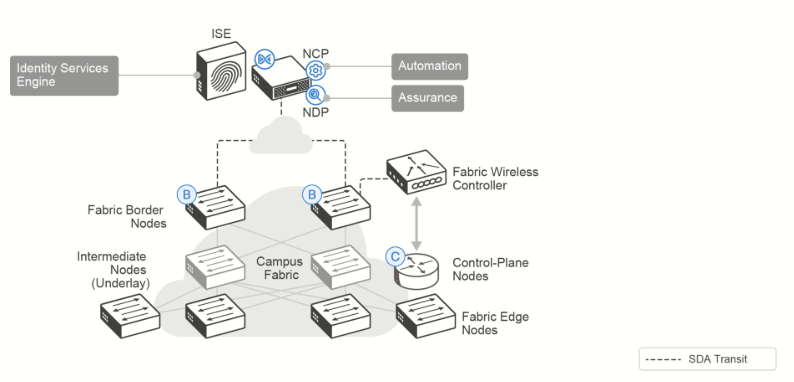
The system is split between management applications (the brains) and fabric nodes (the muscle).
The Brains (Management & Security)
-
Cisco DNA Automation: The GUI-driven central controller. Provides intent-based control (Network Control Platform) and configuration.
-
Cisco DNA Assurance: The health monitor. Uses data collectors (like NDP) to analyze traffic flows and monitor fabric health.
-
Identity Services (Cisco ISE): The security gatekeeper. Maps endpoints to groups and dynamically enforces security policies.
The Muscle (Fabric Device Roles)
-
Control Plane Node: The database/map system. Keeps track of which endpoints are connected to which physical devices.
-
Fabric Border Node: The gateway. Connects external Layer 3 networks (like the internet or a traditional WAN) to the SD-Access fabric.
-
Fabric Edge Node: The point of entry. Connects wired end-user devices (computers, printers) to the fabric.
-
Fabric Wireless Controller (WLC): The wireless anchor. Connects Access Points (APs) and wireless clients to the fabric.