
Multicast - Distribution Trees (3)
First, a quick and critical correction regarding the previous discussion about notation: IGMPv3 is not the only protocol that results in an (S, G) entry. While IGMPv3 is the only version that allows a host to explicitly request an (S, G) join from the very start, routers will absolutely create (S, G) entries when using IGMPv1 or IGMPv2. In those older versions, the host requests a generic (*, G) join, but the moment a source actually starts broadcasting data, the routers must build an (S, G) state entry to track and forward that specific traffic stream.
Multicast Distribution Trees Overview
Multicast routers build loop-free distribution trees to control the path traffic takes to reach receivers. Traffic is only replicated where branches split, and routers dynamically update these trees using two processes:
-
Pruning: When all receivers on a network segment leave a group, routers cut (prune) that branch to stop unnecessary traffic.
-
Joining: When a new receiver becomes active, routers dynamically add the branch back to resume traffic.
Source Trees (Shortest Path Trees - SPT)
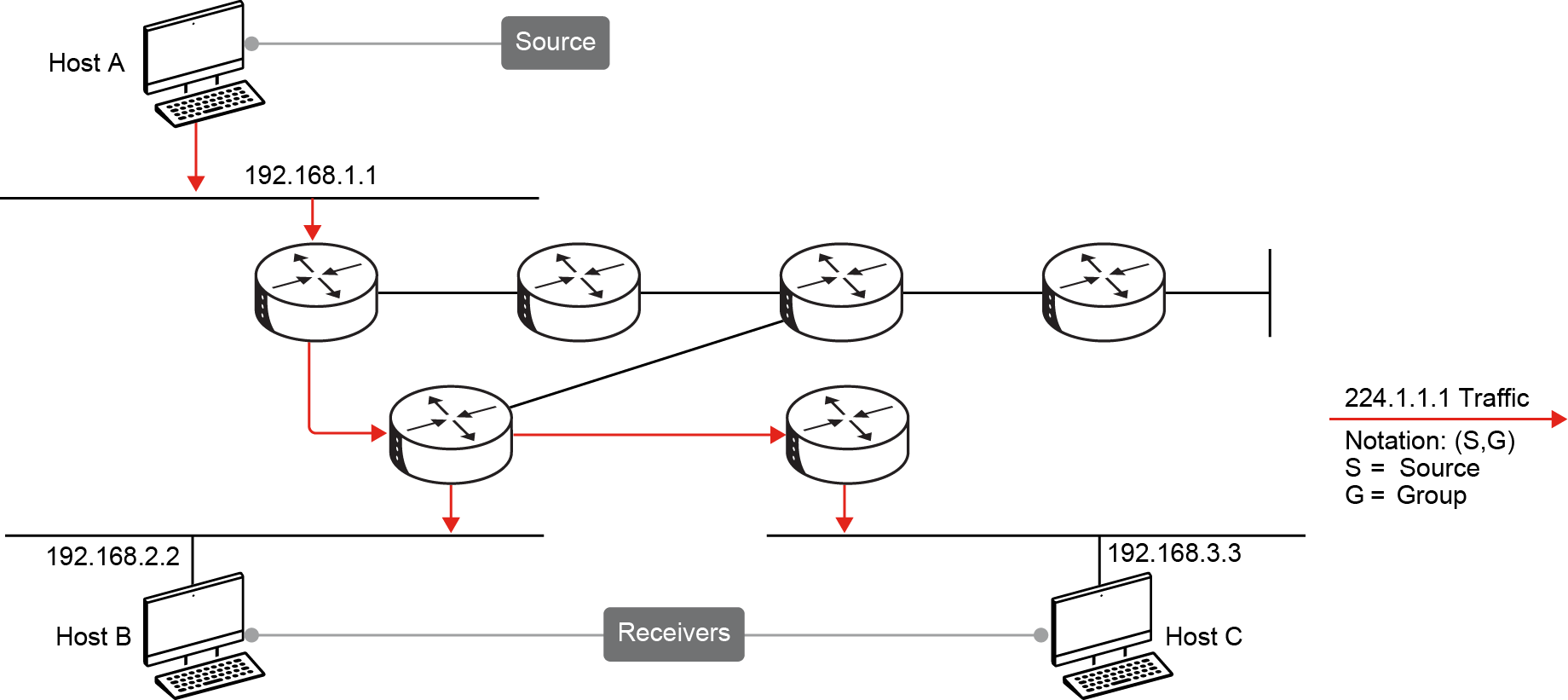
A source tree roots itself directly at the originating traffic source and branches out to the receivers.
-
Notation: Written as (S, G), where S is the source IP address and G is the multicast group address.
-
Example from image (192.168.1.1, 224.1.1.1)
-
-
Scalability: A separate, unique tree must exist for every single source sending to a group. If Host B also starts sending to 224.1.1.1, a completely new tree is built: (192.168.2.2, 224.1.1.1).
-
Pros: Creates the most optimal path with the lowest possible network latency.
-
Cons: High router memory overhead. Routers must maintain state information for every individual source, which can strain resources in large networks.
Shared Trees
-
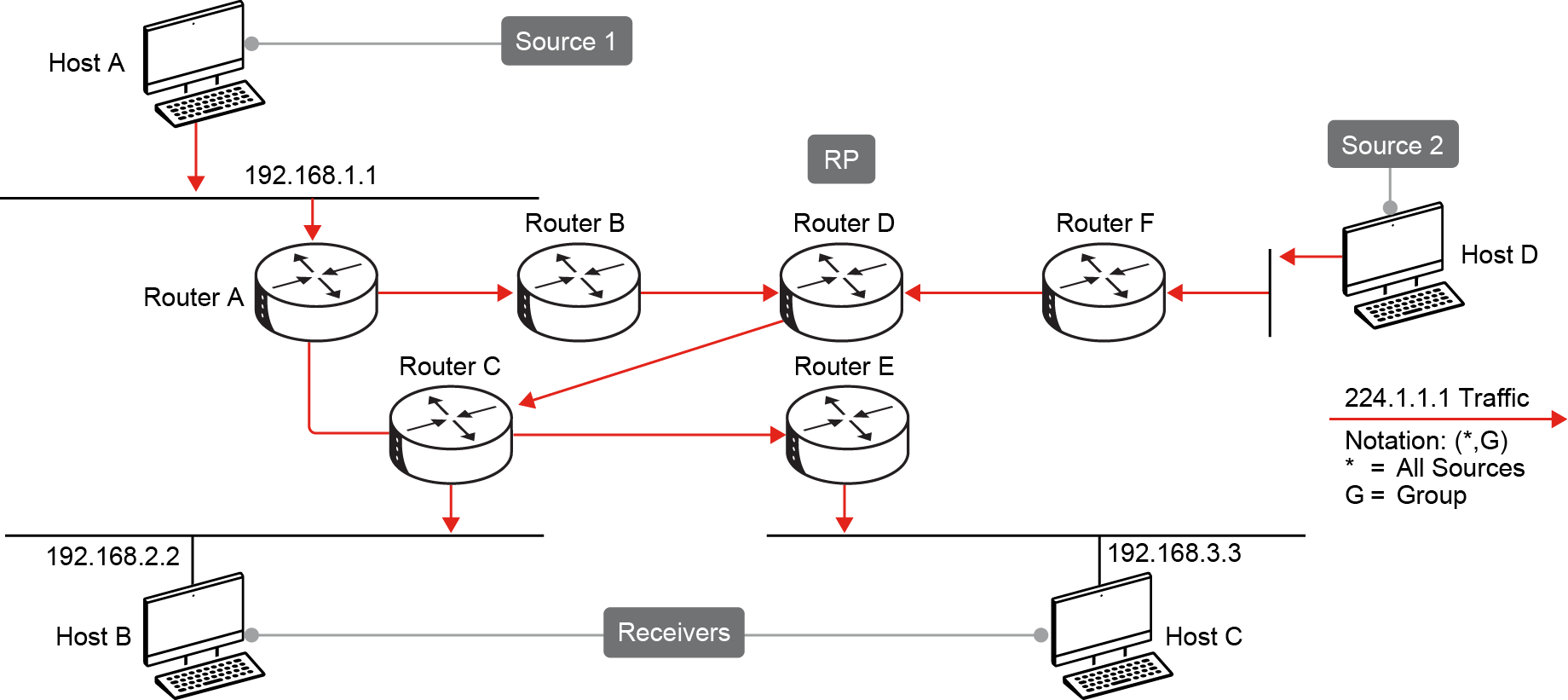
Notation: Written as (, G), where the asterisk () is a wildcard representing "all sources" and G is the multicast group address.
-
Example from image: (*, 224.1.1.1)
-
-
Mechanics: This tree is unidirectional. Sources send their traffic up to the RP, and the RP forwards it down the shared tree to the receivers.
-
Pros: Low router memory overhead. Routers only need to maintain one routing state entry for the entire group, regardless of how many sources are transmitting.
-
Cons: Suboptimal paths and higher latency. Because all traffic must detour through the RP, a path may be physically longer than necessary.
-
Example: In the image, the direct physical path from Source 1 to Host B is through Router A and Router C. Because Router D is the RP, traffic is forced to travel from Router A -> B -> D -> C, adding extra hops.
-
Comparison for the ENCOR Exam
| Characteristic | Source Tree (SPT) | Shared Tree |
| Root Location | Directly at the Source | At the Rendezvous Point (RP) |
| Mroute Notation | (S, G) | (*, G) |
| Path Efficiency | Optimal (Lowest Latency) | Suboptimal (Higher Latency) |
| Router Memory State | High (Scales per source) | Low (Scales per group) |
| Design Risk | Router CPU/Memory exhaustion | Poor RP placement causing traffic bottlenecks |