SD-Access - The need for Cisco SD-Access
1. Traditional Campus Network Challenges
Managing legacy enterprise networks introduces massive operational overhead due to manual workflows and fragmented toolsets.
Configuration & Deployment Challenges
-
Manual & Box-by-Box: Setting up switches requires manual configuration via service requests. A single switch can take hours; batches can take weeks.
-
High Risk: Workflows are highly error-prone, time-consuming, and suffer from limited pre- and post-deployment validation.
-
Static Nature: Networks cannot dynamically adapt to changing real-time business needs.
Operational & Visibility Challenges
-
Fragmented Tools: IT teams rely on distinct, outdated management tools across LAN, WAN, and Data Center environments, reducing productivity.
-
Blind Spots: Administrators lack a clear inventory of endpoints and cannot accurately map traffic flows, leading to slow incident resolution.
Wired vs. Wireless Disparate Systems
-
Siloed Infrastructure: Main IT networks, building management systems, and security systems are run by different departments. This causes hardware duplication and inconsistent management.
-
Addressing & DHCP Bloat: Onboarding diverse devices and handling complex DHCP options across different teams results in complicated IP addressing schemes.
-
The Mobility Trap: To allow users to roam (host mobility) across a traditional network, engineers are forced to stretch VLANs, which degrades network stability.
2. Legacy Topology & Policy Complexity
The Layer 2 Loop Nightmare
Traditional topologies like Layer 2 Looped Squares and Looped Triangles introduce extreme complexity:
-
Protocol Tuning: Engineers must manually map Spanning Tree Protocol (STP) priorities to First-Hop Redundancy Protocols (HSRP, VRRP, FHRP) to ensure proper failover behavior.
-
STP Maintenance: Requires constant optimization of root bridges, path costs, priorities, and features like Root Guard.
-
Workaround Technologies: Innovations like Multichassis EtherChannel (VSS, Stacking, vPC) were created just to bypass Layer 2 loop complexities, achieve faster convergence, and simplify star-based topologies.
Policy Rigidity
-
Routed Access Alternative: While routed access topologies simplify troubleshooting, enforcing Quality of Service (QoS) and security requires static ACLs tied directly to physical MAC and IP addresses.
-
Roaming Breakage: In a 3-tier hierarchical design with multiple distribution blocks, maintaining consistent policies when a user roams between distribution pairs is incredibly difficult.
3. The Core Campus Dilemma (The 5 "Withouts")
Before SD-Access, it was nearly impossible to achieve the following capabilities concurrently without introducing immense design complexity:
-
Host mobility without stretching Layer 2 VLANs.
-
Network segmentation without deploying MPLS.
-
Role-based access control without end-to-end Cisco TrustSec infrastructure.
-
Common wired/wireless policy without using multiple disparate tools.
-
Cross-domain consistency (Campus, WAN, Branch) without separate tools.
4. The Cisco SD-Access Solution & Core Benefits
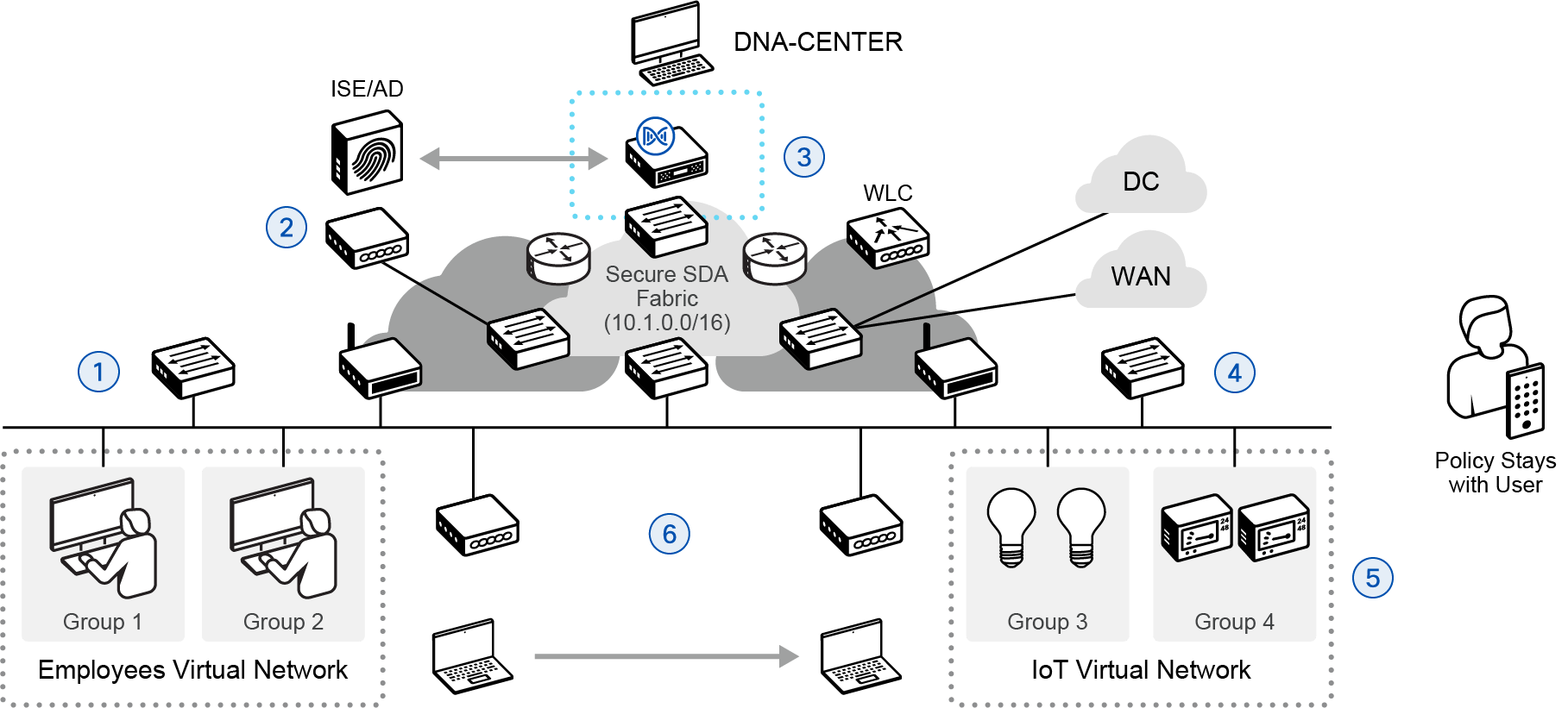
Cisco SD-Access is an intent-based networking solution that automates end-to-end segmentation across user, device, and application traffic without requiring a physical network redesign.
Key Technical Benefits
-
Single Pane of Glass: Uses Cisco DNA Center (now Cisco Catalyst Center) for centralized automation, contextual visibility, and rapid troubleshooting.
-
Routed Access Underlay: Eliminates STP loops by utilizing a fully routed underlay with Equal-Cost Multipath (ECMP), enabling traffic to load-balance across multiple optimal paths.
-
Stretched Subnets via Overlay: Allows IP subnets to be stretched cleanly across the fabric fabric overlay without risking Layer 2 loops.
-
Anycast Default Gateway: Enables seamless endpoint mobility. Wireless LAN (WLAN) traffic is switched locally at the fabric Edge Node, ensuring uninterrupted policy application as users roam.
-
Universal Port Flexibility: Enables any service or policy to be dynamically applied to any physical switch port.
-
Two-Level Segmentation:
-
Macro-segmentation: Uses Virtual Networks (VNs / VRFs) to separate major traffic types at Layer 3.
-
Micro-segmentation: Uses Scalable Group Tags (SGTs)—formerly known as Security Group Tags—to enforce role-based access control within the same subnet, independent of IP addresses.
-