
Campus LAN Design Fundamentals
1. Network Topologies: Flat vs. Hierarchical
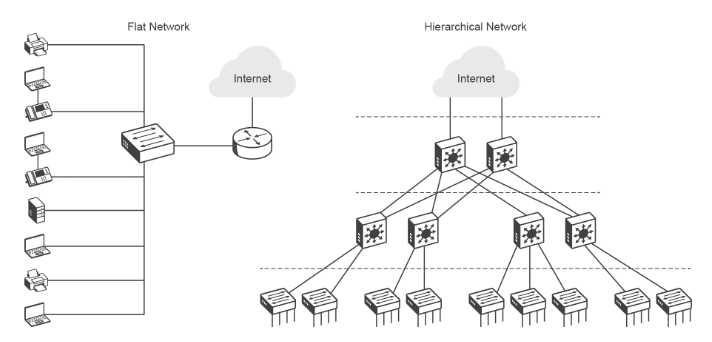
| Feature | Flat Network Architecture | Hierarchical Network Architecture |
| Structure | All devices connect via L2 switches on a single subnet. | Multi-tiered design dividing network functions into distinct layers. |
| Broadcast Domains | Single large broadcast domain; every packet consumes CPU across all end hosts. | L3 devices (routers/L3 switches) bound and isolate broadcast domains. |
| Scalability | Poor performance as host count increases. | Highly scalable; easy to add blocks/buildings without redesigning. |
2. The 3-Tier Enterprise Campus Model
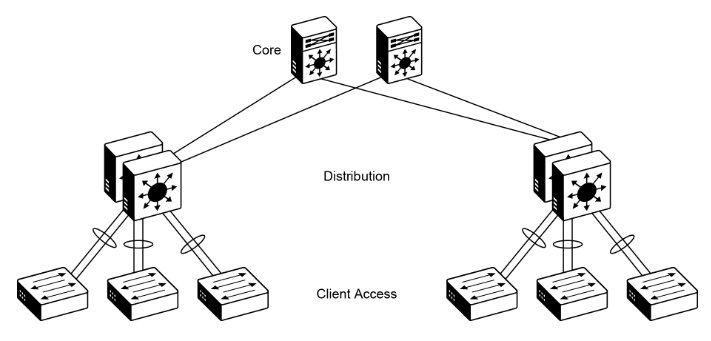
Core Layer (The Backbone)
-
Primary Function: High-speed, low-latency transport across the enterprise.
-
Key Requirements: High availability, fast convergence, modular scalability, and minimal packet processing overhead.
Distribution Layer
-
Primary Function: Aggregates wiring closets (access layer) and enforces policy-based control.
-
Key Responsibilities: Workgroup segmentation, security policy enforcement, problem isolation, and campus WAN aggregation.
Access Layer (Client Access)
-
Primary Function: Provides end-user devices, workstations, servers, and teleworkers direct access to network communication services.
3. Access Layer Architectures: L2 Switched vs. L3 Routed
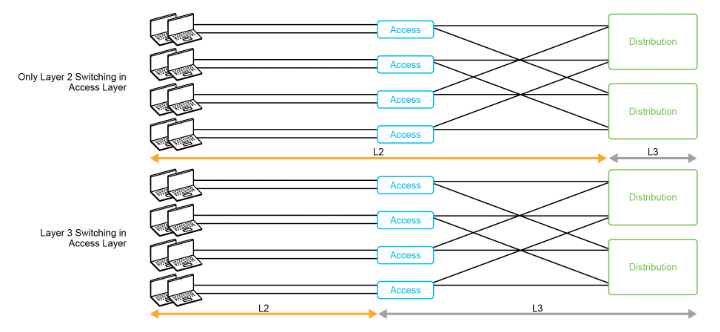
Option 1: Traditional Layer 2 Access (Switched)
-
L2/L3 Boundary: VLANs extend through access switches and terminate at the Distribution layer.
-
Spanning Tree Protocol (STP): Required to prevent loops, which results in blocking ~50% of available redundant uplinks.
-
VLAN Flexibility: VLANs can theoretically span multiple access switches (though discouraged in modern design).
-
Pros/Cons: Cheaper and simpler initial deployment, but wastes bandwidth due to STP blocking.
Option 2: Routed Layer 3 Access (Routed)
-
L2/L3 Boundary: VLANs terminate locally on the Access layer switch. Links between Access and Distribution are L3 routed links.
-
Uplink Utilization: Eliminates STP blocking on uplinks; all links actively forward traffic via Layer 3 Equal-Cost Multi-Pathing (ECMP) routing.
-
VLAN Locality: VLANs are strictly local to a single access switch and cannot span across switches.
-
Design Challenges: Requires extra planning for traffic isolation (e.g., separating guest traffic from internal corporate traffic using VRFs).