
EIGRP
Features
1. Protocol Nature & Standards
-
Standardization: Originally Cisco proprietary; published as an open standard in 2013 (RFC 7868). Cisco retains development control, and EIGRP Stub functionality remains proprietary.
-
Hybrid / Advanced Distance Vector:
-
Distance Vector behavior: Learns network topology exclusively from directly connected neighbors (routing by rumor).
-
Link-State behavior: Uses a Hello protocol for neighbor discovery/adjacency and sends incremental updates only when topology changes occur.
-
2. DUAL Engine & Rapid Convergence
-
DUAL (Diffusing Update Algorithm): The core computational engine running EIGRP. Guarantees loop-free paths and calculates backup routes across the domain.
-
Local Backup Routes: Stores backup routes (Feasible Successors) locally in the topology table for instant failover if the primary route (Successor) fails.
-
Active Querying: If no backup route exists in the local topology table during a failure, EIGRP sends queries to neighbors to actively discover an alternate path.
3. Subnetting & Load Balancing
-
Classless Routing: Advertises subnet masks alongside network prefixes, fully supporting VLSM (Variable Length Subnet Masks) and discontiguous subnets.
-
Flexible Load Balancing: Supports both Equal-Cost Load Balancing (ECLB) and Unequal-Cost Load Balancing (UCLB) (via the
variancecommand) to optimize path utilization.
4. Multi-Address Family & Advanced Integration
-
Routed Protocol Support: Native support for IPv4 and IPv6 (legacy IPX/AppleTalk deprecated).
-
Service Advertisement Framework (SAF): Can distribute VoIP dial plan information across large networks by integrating with Cisco Unified Communications Manager (CUCM) and supporting Performance-Based Routing.
5. Bandwidth Efficiency & Packet Transport
-
No Periodic Updates: Unlike traditional distance vector protocols (e.g., RIP), EIGRP never sends periodic full routing table dumps.
-
Partial Updates: Sends updates containing only state changes, not the full routing table.
-
Bounded Updates: Propagates topology updates only to routers directly affected by the change.
-
Transport Protocols: Uses Multicast and Unicast (never Broadcasts), preventing CPU overhead on end stations:
-
IPv4 Multicast Address:
224.0.0.10
-
Fundamenals, Tables and Packet Types

1. EIGRP Transport & Mechanics
-
Layer 3 Protocol: Runs directly over IP using IP Protocol 88.
-
Reliable Transport Protocol (RTP): Handles guaranteed, ordered delivery of specific EIGRP packets.
-
Addressing: Uses multicast address
224.0.0.10for segment-wide transmissions, as well as unicast for direct peer communication. -
Reliability: Only selected packets (Updates, Queries, Replies) are sent reliably via RTP and require acknowledgments (ACKs).
2. The Three EIGRP Data Structures (Tables)
| Table | Contents & Purpose |
| Neighbor Table | Tracks all adjacent EIGRP routers, listing their primary IP addresses and connected local interfaces. |
| Topology Table | Stores all destination routes advertised by adjacent neighbors, along with neighbor-advertised metrics and total calculated metrics. |
| Routing Table | Houses only the best path(s) selected by DUAL for active data packet forwarding. |
3. Metric Definitions & DUAL Path Terminology
-
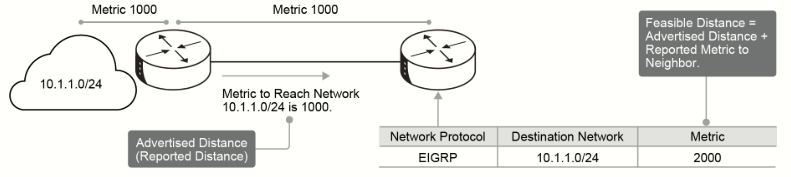
Advertised Metric (Reported Distance): The metric value a neighboring router advertises for a destination (the neighbor's internal cost to reach that route).
-
Total Metric (Feasible Distance): The sum of the neighbor's Advertised Metric plus the local link cost to reach that neighbor.
-
Successor: The primary, lowest-metric best path to a destination; installed directly into the IP routing table.
-
Feasible Successor (FS): A pre-calculated, loop-free backup path stored in the topology table; allows immediate failover if the Successor fails.
4. EIGRP Route States
-
Passive State: The normal, operational state for a route; indicates the router is stable and not recomputing the path.
-
Active State: The convergence/failure state; occurs when a Successor fails and no Feasible Successor exists, forcing the router to recompute the route by querying neighbors.
5. EIGRP Packet Types
| Packet Type | Transport | Delivery | Primary Purpose |
| Hello | Multicast | Unreliable | Discovers and maintains neighbor adjacencies (contains ACK number = 0). |
| Update | Multicast / Unicast | Reliable | Communicates route changes (multicast) or synchronizes topology tables with new neighbors during startup (unicast). |
| Query | Multicast | Reliable | Sent when a route enters the Active state to search for an alternate path. |
| Reply | Unicast | Reliable | Sent in direct response to a Query packet. |
| ACK | Unicast | Unreliable | Acknowledges Updates, Queries, and Replies. It is a Hello packet containing no data and a non-zero ACK number. |
| Request | Multicast / Unicast | Unreliable | Used in route server applications to request specific information. |
6. Neighbor Discovery & Synchronization Workflow
-
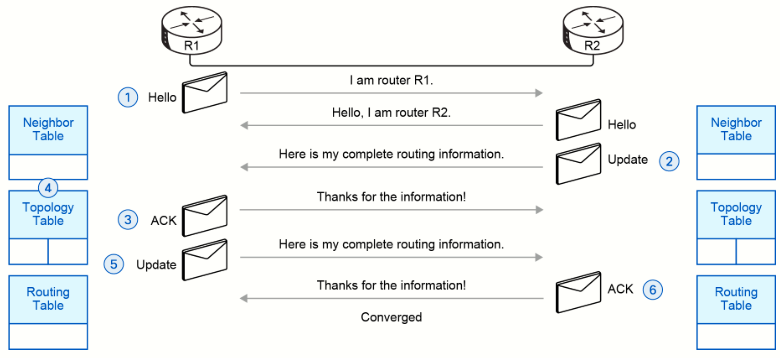
Hello Exchange: A router coming online sends a multicast Hello packet. The receiving router responds with its own Hello to form a neighbor relationship.
-
Topology Exchange: Once the neighbor relationship is established, routers exchange Update packets containing known routes.
-
Acknowledgment: Receiving routers reply with ACK packets to confirm receipt of Update packets.
-
Topology Assimilation: The router populates its topology table with the received routes, calculates metrics, and installs the Successor paths into the routing table.
Establishing EIGRP Neighbor Adjacency

1. Required Matching Parameters for Adjacency
To form an EIGRP neighbor adjacency, four parameters contained in the EIGRP Hello packet must match between neighbors:
-
Autonomous System (AS) Number: Must match exactly across routers to exchange routing information.
-
K-Values: Metric calculation weights must match; mismatches prevent neighbor formation and impact convergence.
-
Common Subnet (Primary IP): Routers must share a primary IP subnet. Secondary IP addresses cannot be used to establish neighbor adjacencies.
-
Authentication: Method and password/key string must match.
2. Key EIGRP vs. OSPF Adjacency Differences
-
Hello / Hold Timers: Do NOT need to match in EIGRP (timer mismatches will prevent OSPF adjacencies, but EIGRP will still form an adjacency).
-
Router ID: Significantly less critical in EIGRP than in OSPF. Verified using the command
show ip protocols. -
AS Number vs. Process ID: EIGRP AS numbers must match across neighbors, whereas OSPF Process IDs are strictly locally significant to an individual router.
3. Passive Interface Behavior
Executing passive-interface on an EIGRP interface:
-
Suppresses outbound Hello packets, immediately preventing or tearing down neighbor adjacencies.
-
Suppresses all incoming and outgoing routing updates on that interface.
4. AS Number Design & Best Practices
-
Scope: Has local enterprise significance, not global BGP-style significance.
-
Best Practices: Match your organization's BGP AS number if assigned, or use AS 1 for all internal EIGRP routers.
-
Multi-AS Deployments: Using multiple EIGRP AS numbers is valid in specific design scenarios, such as DMVPN topologies.
Metrics
1. The 5 Vector Metrics & K-Values
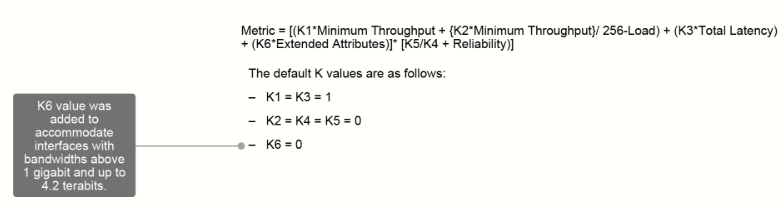
EIGRP does not use a single metric; it uses five interface characteristics. K-values act as weights (coefficients) to determine if a component is included in the composite metric calculation.
| K-Value | Component | Default Value | Measured Unit & Description |
| K1 | Bandwidth | 1 | Lowest bandwidth along the entire path (in kbps). |
| K2 | Load | 0 | Worst load on the path based on packet rate (1 to 255). |
| K3 | Delay | 1 | Cumulative sum of all interface delays along the path (tens of microseconds). |
| K4 | Reliability | 0 | Worst link reliability along the path (1 to 255; 255 = 100% reliable). |
| K5 | MTU | 0 | Smallest MTU size along the path (bytes). |
-
Default Composite Metric: Only Bandwidth (K1) and Delay (K3) are used:
Metric = 256 * (Bandwidth + Delay) -
K-Value Mismatches: K-values are carried in EIGRP Hello packets. Mismatched K-values prevent or reset neighbor adjacencies.
-
Role of MTU: MTU is never used in the metric calculation formula. It is carried in updates and used strictly as a tiebreaker when selecting paths if maximum equal-cost paths are exceeded (highest minimum MTU wins).
2. EIGRP Path Manipulation: Delay vs. Bandwidth
When steering traffic or altering EIGRP path selection, always modify delay, never bandwidth.
-
Why modify
delay? Delay is cumulative (summed across every link in the path). Changing it on an interface guarantees a predictable metric change. -
Why avoid modifying
bandwidth?-
EIGRP only evaluates the lowest single bandwidth link along the path. Changing bandwidth on a faster link may have zero effect if a slower link exists elsewhere on the route.
-
Altering interface bandwidth breaks or disrupts other network services, such as QoS calculations and telemetry/monitoring metrics.
-
3. EIGRP Classic Metrics vs. Wide Metrics
High-speed links (>1 Gbps) present a scaling issue in Classic EIGRP because minimum configurable delay is capped, making 10GE links look identical to 1GE links.
| Feature | Classic Metrics | Wide Metrics |
| Bit Length | 32-bit composite metric | 64-bit composite metric |
| Max Throughput | Scaled accurately up to 1 Gbps | Scaled accurately up to ~4.2 Tbps |
| Latency Measurement | Measured in microseconds | Measured in picoseconds |
| K-Value Extension | K1 through K5 | Adds K6 (reserved for extended attributes) |
| RIB Compatibility | Fits directly into the 32-bit RIB | Requires scaling via metric rib-scale |
Path Selection
1. Table Management & Dual-Stack Operations
-
Neighbor & Topology Tracking: Upon adjacency, routers exchange topology data and run the path selection process. Continuously received Hellos ensure topology stability.
-
Dual-Stack Environments: IPv4 and IPv6 run independently; each routed protocol maintains its own separate Neighbor Table and Topology Table.
-
RIB Installation: The best path calculated from the EIGRP topology table is submitted to the local Routing Engine (RIB). It is installed provided no route with a lower Administrative Distance (e.g., a static route) exists.
2. Distance Terminology
| Metric Term | Synonyms | Definition | Formula / Calculation |
| Advertised Distance (AD) | Reported Distance (RD) | The metric cost from the neighboring router to the destination network. | Neighbor's internal metric |
| Feasible Distance (FD) | Total Metric | The total end-to-end metric cost from the local router to the destination network. | Neighbor's AD + Link Cost to Neighbor |
3. Path Roles & The Feasibility Condition
-
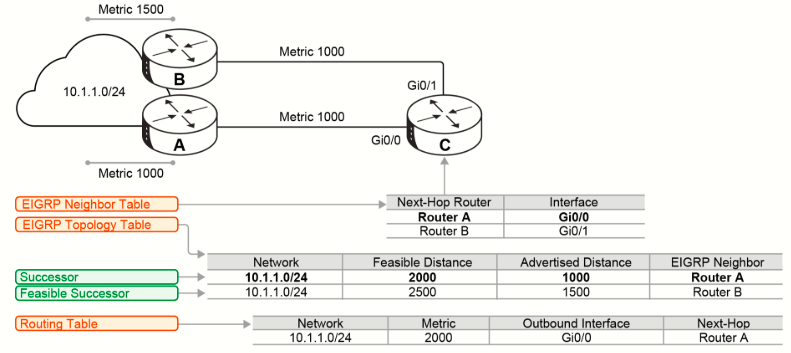
Successor: The primary, best path to a destination network. It has the lowest Feasible Distance (FD) and is installed into the IP routing table.
-
Feasible Successor (FS): A pre-calculated, loop-free backup path kept in the topology table for fast failover.
-
Feasibility Condition (FC): To qualify as a Feasible Successor, a candidate path must satisfy:
Neighbor's Advertised Distance (AD) < Current Successor's Feasible Distance (FD)-
Purpose: Ensures the neighboring router is "closer" to the destination than our primary path, guaranteeing the backup path is 100% loop-free.
-
4. DUAL Route States & Convergence Workflow
-
Passive State: The normal, stable state for a route. No topology recalculation is taking place.
-
Active State: The convergence state triggered when a Successor fails and NO Feasible Successor exists. The router must actively query its neighbors to recompute a path.
-
Failover Logic:
-
If Successor fails AND an FS exists: DUAL immediately installs the FS as the new Successor. Route remains Passive (instant convergence, zero query overhead).
-
If Successor fails AND NO FS exists: Route transitions to Active. DUAL sends Query packets to neighbors to find a new path.
-
5. Acronym Disambiguation: EIGRP AD vs. Global AD
-
EIGRP Advertised Distance (AD / RD): A protocol-specific metric value advertised by a neighbor describing its own cost to a destination network.
-
Administrative Distance (AD): A global router feature used by the Routing Engine to rate the believability of different routing sources (e.g., Static = 1, Internal EIGRP = 90, OSPF = 110).
-
Example: If EIGRP and OSPF learn the exact same prefix, the RIB compares their Administrative Distances (not EIGRP metrics) and installs the EIGRP route due to its lower value (90 vs. 110).
-