
SD-WAN - Flexible Controller Deployment Options
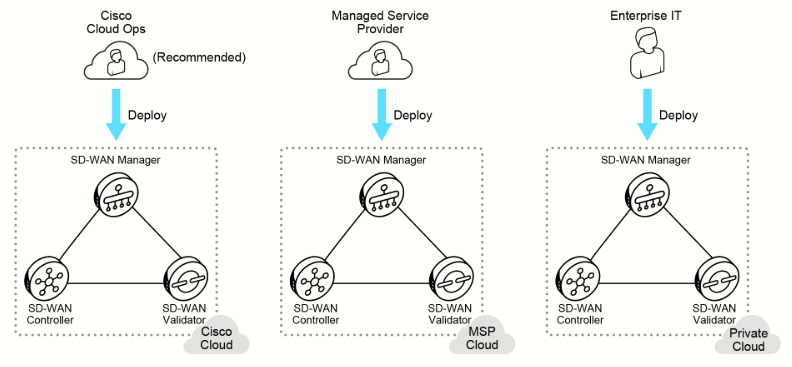
The Cisco Catalyst SD-WAN architecture provides maximum flexibility regarding the deployment of the controllers.
You can deploy the three controller types (Cisco Catalyst SD-WAN Manager, Cisco Catalyst SD-WAN Controller, and Cisco Catalyst SD-WAN Validator) according to the following models:
Why Are All Three Nodes Called "Controllers"?
In Software-Defined Networking (SDN), the term "controllers" is used collectively for the centralized management infrastructure to contrast them against the hardware data plane (the routers) that forward raw data packets.
While it is true that only the SD-WAN Controller explicitly manages the control plane (routing tables and policy logic), the fabric cannot function without centralized management control (SD-WAN Manager) and centralized orchestration control (SD-WAN Validator). Because these three components are centralized software elements that collectively control the provisioning, security, and behavior of the entire network fabric, they are referred to as the "controller suite."
1. Cisco CloudOps Managed Cloud (Recommended Model)
-
Infrastructure Hosting: Deployed on public clouds (AWS or Microsoft Azure) by the Cisco CloudOps team across single or multiple zones.
-
Customer Adoption: Most customers select this option because it offers the greatest ease of deployment and flexibility in scaling.
-
Cisco's Responsibilities: Cisco provisions the controllers with necessary certificates, guarantees scale and redundancy requirements, and manages all backups, snapshots, and disaster recovery.
-
Customer Privileges: The customer receives administrative access to the SD-WAN Manager to build configuration templates, control policies, and data policies for their edge devices.
-
Default Subscription Topology:
-
Primary Region: Deploys a single SD-WAN Manager, a single SD-WAN Validator, and a single SD-WAN Controller by default.
-
Secondary/Backup Region: Deploys an extra SD-WAN Validator and an extra SD-WAN Controller for redundancy.
-
2. Managed Service Provider (MSP) or Partner-Hosted Cloud
-
Infrastructure Hosting: Hosted either in a private cloud environment or publicly cloud-hosted inside AWS or Azure instances.
-
Operational Responsibilities: The MSP or partner assumes ownership of provisioning the controllers, managing backups, and handling disaster recovery.
3. On-Premises Private Cloud / Enterprise Data Center
-
Infrastructure Hosting: Deployed inside a private cloud or a local physical data center owned directly by the enterprise organization.
-
Operational Responsibilities: The customer is fully responsible for provisioning the controllers, executing backups, and managing disaster recovery.
-
Target Audience: Typically chosen by highly regulated sectors, such as financial institutions or government-based entities, primarily to satisfy strict security and compliance mandates.
MSP Multi-Deployment Flexibility
-
An MSP can support customers running any one of these three deployment models simultaneously.
-
The MSP can offer various customized service tiers and management options within each deployment framework.