
SD-WAN - Need for SD-WAN
Applications used by enterprise organizations have evolved over the past several years. As a result, the enterprise WAN must evolve to handle the rapidly changing needs placed on it by these new resource-consuming applications, as shown in the following figure.
WAN is evolving to manage a changing application landscape.
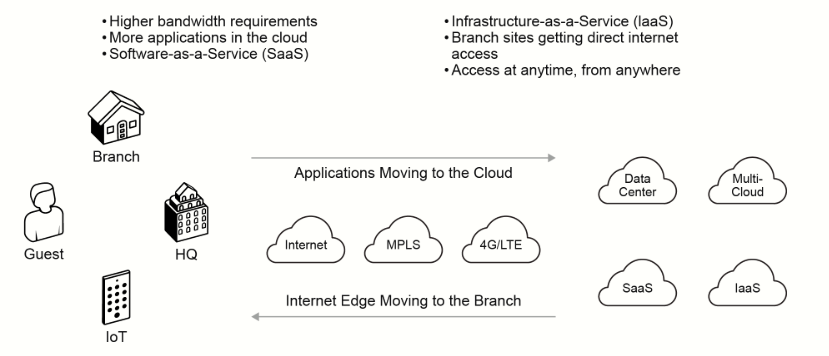
Legacy WAN architectures typically consist of multiple Multiprotocol Label Switching (MPLS) transports, or an MPLS paired with internet or Long-Term Evolution (LTE) transport used in an active-backup deployment, usually with internet or SaaS traffic being sent to a central data center or regional hub for internet access. Issues with these legacy architectures include:
- Insufficient bandwidth
- High-bandwidth costs
- Application downtime
- Poor SaaS performance
- Complex operations
- Complex workflows for cloud connectivity
- Long deployment times
- Policy changes
- Limited application visibility
- Difficulty in securing the network
Cisco Catalyst SD-WAN represents the shift from an older, hardware-based model of legacy WAN to a secure, software-based, virtual IP fabric overlay that runs over standard network transport services.
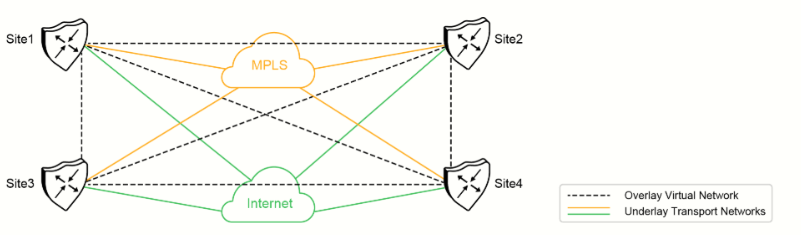
The Cisco Catalyst SD-WAN technology addresses the problems and challenges of common WAN deployments. These are some of the benefits of Cisco Catalyst SD-WAN:
- Centralized network and policy management: It enables operational simplicity, resulting in reduced change control and deployment times.
- Transport link independent: It enables a mix of MPLS and low-cost broadband or any combination of transports in an active-active mode, optimizing capacity and reducing bandwidth costs.
- Transport-independent overlay: It extends to the data center, branch, and cloud.
- Deployment flexibility: It is a separated control plane and data plane.
- Robust and comprehensive security: It includes strong encryption of data, end-to-end network segmentation, router and controller certificate identity with a zero-trust security model, control plane protection, application firewall, and insertion of Cisco Umbrella, firewalls, and other network services.
- Seamless connectivity: It is connectivity to a public cloud and movement of the WAN edge to the branch.
- Application visibility and recognition: Application-aware policies with real-time service-level agreement (SLA) enforcement.
- Dynamic optimization of SaaS applications: It results in improved application performance for users.
- Rich analytics with visibility into applications and infrastructure: It enables rapid troubleshooting and helps with forecasting and analysis for effective resource planning.