
Lab 2 - Addressing, Routing and NAT
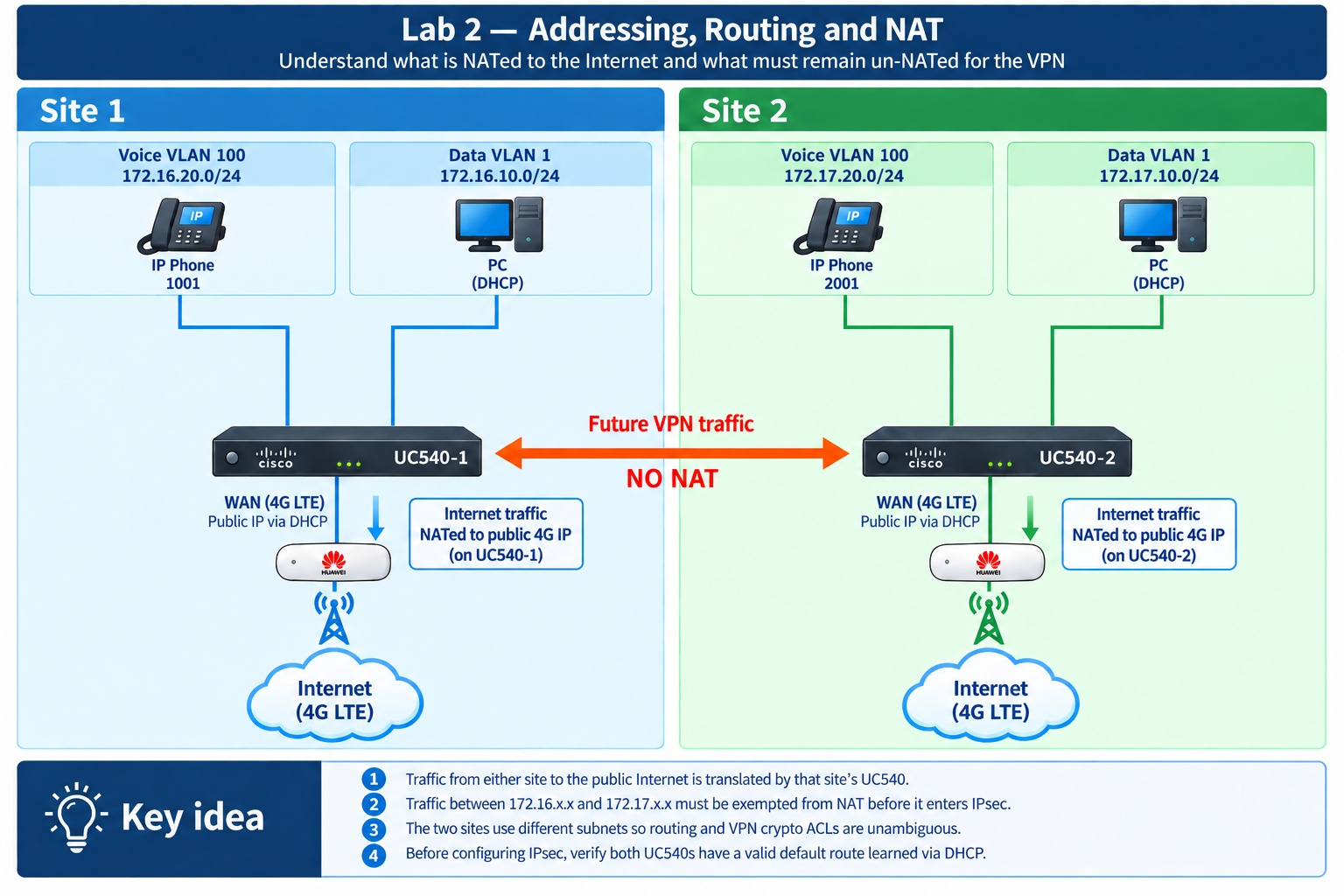
The purpose of this lab is to understand the traffic flow before we build the VPN: what gets routed locally, what gets PAT/NATed to the LTE public IP, and what must later remain un-NATed so IPsec can carry it between sites.
Our addressing is already fixed:
| Site 1 | Site 2 | |
|---|---|---|
| Data VLAN 1 | 172.16.10.0/24 |
172.17.10.0/24 |
| Voice VLAN 100 | 172.16.20.0/24 |
172.17.20.0/24 |
| Data gateway | 172.16.10.1 |
172.17.10.1 |
| Voice gateway | 172.16.20.1 |
172.17.20.1 |
| WAN | DHCP via LTE/relayd | DHCP via LTE/relayd |
The UC540 is doing normal Layer-3 routing between its local BVIs, while Internet traffic exits Fa0/0 and is translated to the LTE WAN address. In CCA, open:
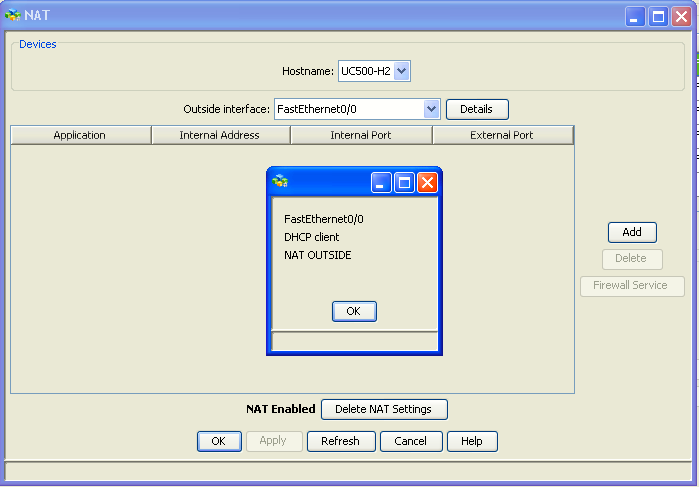
Configure → Security → NAT
Make sure FastEthernet0/0 is still the Outside interface. Do not change anything yet. Cisco CCA manages UC500 NAT from this page.
Now check the actual IOS NAT configuration on both UC540s:
|
|
|
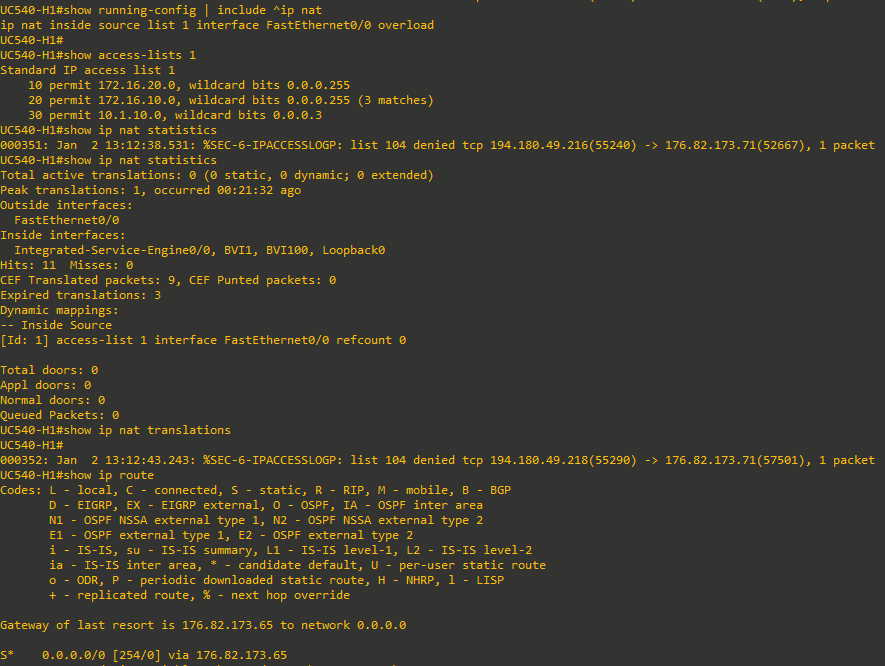
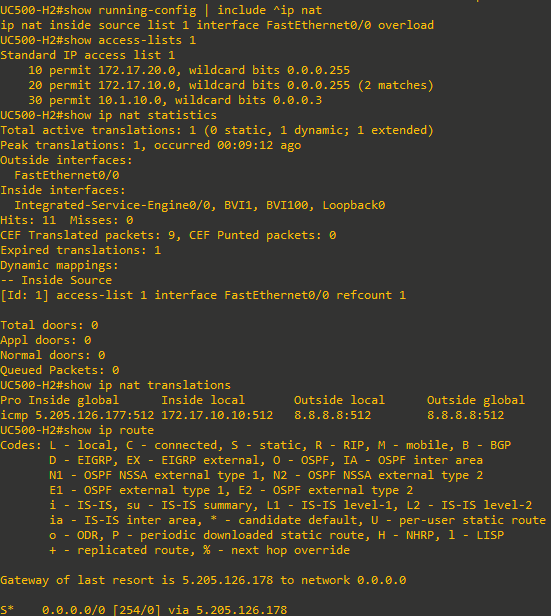
The inside interfaces are the BVIs, while Fa0/0 is ip nat outside. The factory configuration follows exactly this design.
So today, Internet traffic behaves like this:
172.16.10.x
      |
     BVI1
      |
     UC540
      |
      | NAT/PAT
      v
Fa0/0 public LTE IP
      |
   Internet
The same applies to the Voice VLAN if it needs Internet access. The important VPN concept is the opposite. When Site 1 later sends traffic toward Site 2, we must preserve the original private addresses:
172.16.10.x ---> 172.17.10.xWe do not want:
Public-LTE-IP ---> 172.17.10.xbecause the IPsec crypto policy is built around the original protected subnets. With IOS PAT, VPN traffic normally needs to be excluded from NAT before encryption; Cisco documents this using a NAT-exemption ACL/route-map design.
For the standard CCA Multisite Manager workflow we are going to use later, CCA focuses on the UC500 Data VLAN when defining the site-to-site VPN. Cisco's Multisite Manager explicitly reads each site's Data VLAN address and subnet and uses that as the internal addressing for VPN configuration.
So for now, do not manually create any NAT exemption. We only want to understand and record the current NAT state before CCA modifies it during the multisite/VPN configuration.
Current NAT behavior
Both sites use the same PAT design:
ip nat inside source list 1 interface FastEthernet0/0 overloadSo any source network permitted by ACL 1 is translated to the address currently assigned to FastEthernet0/0.
Site 1
ACL 1 contains:
10 permit 172.16.20.0 0.0.0.255
20 permit 172.16.10.0 0.0.0.255
30 permit 10.1.10.0 0.0.0.3
Therefore NAT currently applies to:
172.16.10.0/24— Data VLAN 1172.16.20.0/24— Voice VLAN 10010.1.10.0/30— internal CUE/ServiceEngine network
Site 2
Identical conceptually, using its 172.17.x.x networks.
Inside and outside interfaces
Both routers correctly report:
Outside:
  FastEthernet0/0

Inside:
  Integrated-Service-Engine0/0
  BVI1
  BVI100
  Loopback0
This matches the UC540 architecture we discussed earlier:
BVI1       → Data LAN
BVI100     → Voice LAN
Loopback0/
ServiceEngine → CUE

        UC540 routing/NAT

Fa0/0      → LTE WAN
Everything leaving the internal networks toward the Internet can therefore be PATed through Fa0/0. Site 2 is the clearest example to see PAT working (I started a ping to 8.8.8.8 from Windows XP PC on data network):
Inside local             Inside global
172.17.10.10:512   →     5.205.126.177:512
So the LTE address is reaching the UC540 itself through your OpenWrt/relayd setup exactly as intended. Site 1 simply had no active NAT translation at the instant I ran the command, but it already shows NAT hits and expired translations, so NAT has been used successfully there as well.
Routing
Both UC540s also have a DHCP-learned default route.
Site 2:
0.0.0.0/0 via 5.205.126.178Site 1:
0.0.0.0/0 via 176.82.173.65The [254/0] is normal for a default route installed by DHCP: administrative distance 254, metric 0. So Internet routing is already complete.
What changes once we build the VPN
This is the key concept of Lab 2.
Today this traffic:
172.16.10.x → Internetgets translated:
172.16.10.x → Site 1 public LTE IPThat is correct. But later, traffic such as:
172.16.10.x → 172.17.10.xmust not be translated. IPsec needs to see the original private networks:
172.16.10.0/24 ↔ 172.17.10.0/24So the final design becomes:
Destination = Internet
        ↓
       NAT
        ↓
Public LTE address


Destination = Other site
        ↓
     NO NAT
        ↓
      IPsec
        ↓
Remote private subnet
Your current NAT rule does not yet distinguish by destination because ACL 1 is a standard ACL and only matches the source address. That is fine right now. When we configure the site-to-site VPN, the NAT configuration must be adapted so VPN traffic is exempted while ordinary Internet traffic continues to be PATed.
Also, those ACL 104 messages such as:
%SEC-6-IPACCESSLOGP: list 104 denied tcp ...are just unsolicited packets arriving from the public Internet and being blocked on the WAN interface. They are unrelated to the NAT/VPN problem.